


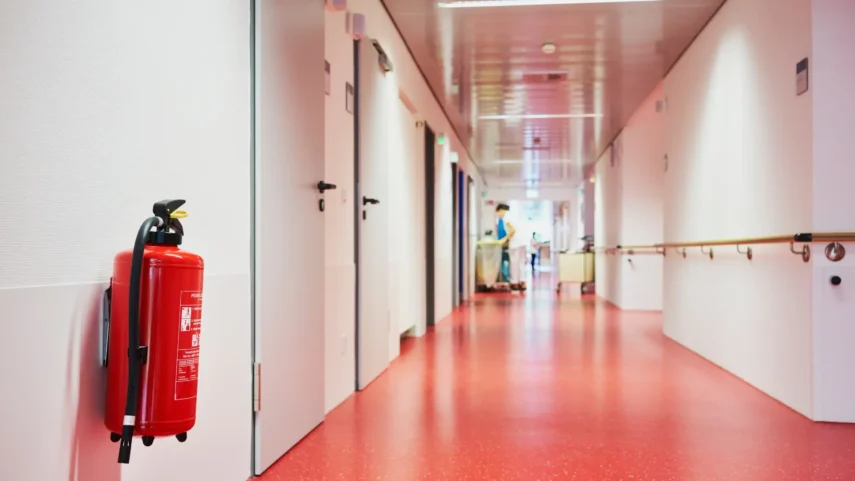
Since 1985, Dijinet, which installs addressable fire detection systems in Turkey’s leading institutions, offers supply, engineering, installation, and periodic maintenance services under one roof.
Why Does a Hospital Fire Detection System Require a Special Approach?
When a fire alarm goes off in an office building, everyone is expected to evacuate the building on their own. This scenario is not applicable in a hospital. An intensive care patient, a patient on the operating table, a patient undergoing dialysis treatment, a baby in the neonatal unit — none of these can quickly evacuate the building. This single difference fundamentally changes the design, component selection, and operating model of hospital fire detection systems.
The Regulation on Fire Protection of Buildings in Turkey classifies hospitals among ‘high hazard class’ buildings. This classification affects every layer, from smoke detector type to panel capacity, from audible warning infrastructure to emergency evacuation plan. Furthermore, compliance with EN 54 standards has become a critical control item in Ministry of Health facility inspections.
As Dijinet, we have implemented hundreds of corporate projects since 1985. We prepared this content to truly answer the question ‘what do I need and how do I choose the right system’ for a hospital management.
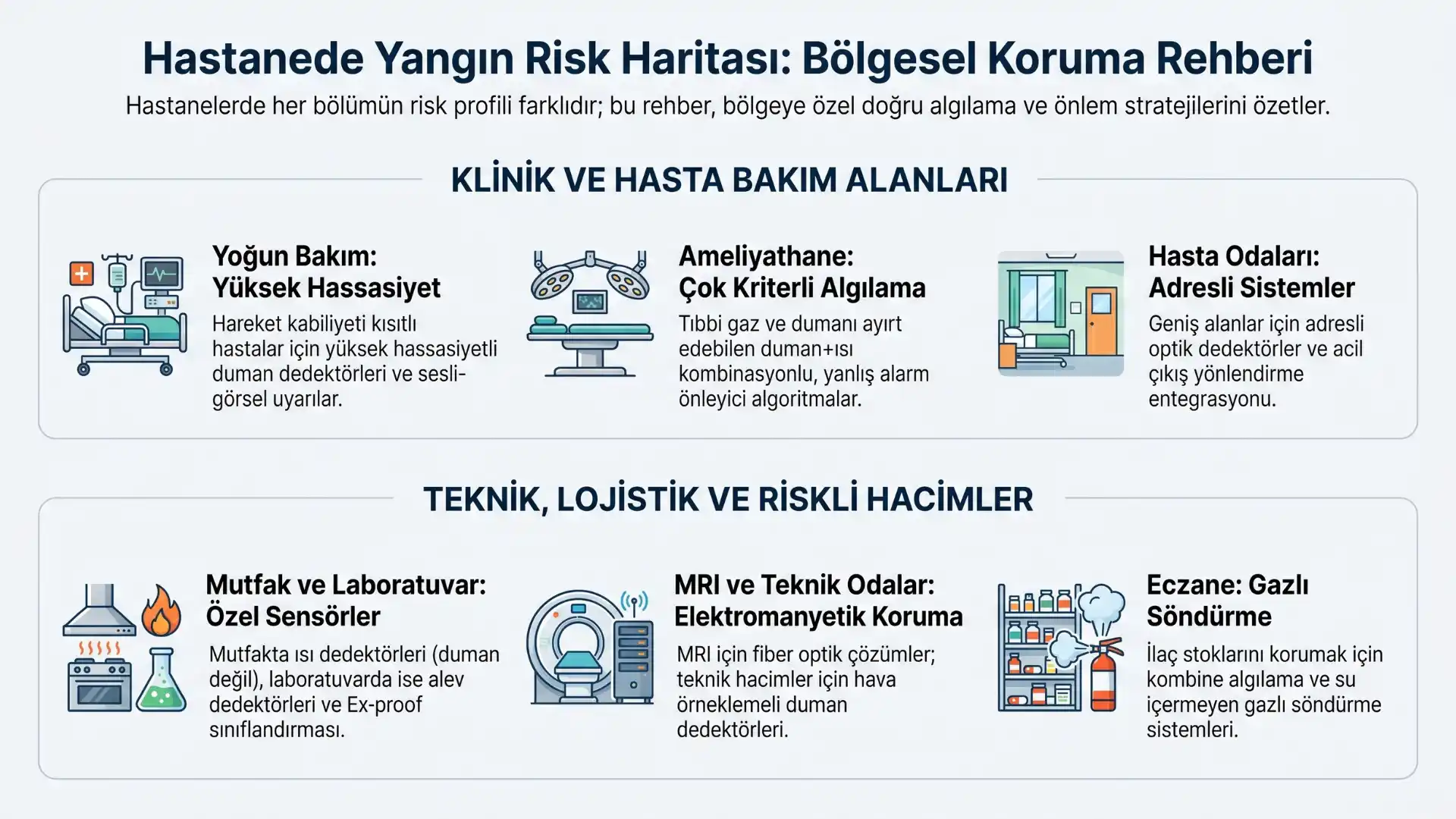
Fire Risk Map in a Hospital: Not Every Section Is the Same
When designing a hospital fire detection system from scratch, the most critical step is to acknowledge that different areas of the building have different risk profiles. Placing the same detector in all areas leads to both insufficient protection and the risk of unnecessary false alarms.
| Area | Prominent Risk and Recommended Approach |
| Intensive Care Unit | Zero mobility. Early warning is vital. Addressable, high-sensitivity smoke detector + audible-visual alarm combination. |
| Operating Room | Medical gases, electrocauterization smoke. Multi-criteria (smoke+heat) detector, false alarm suppression algorithm required. |
| Laboratory and Chemical Storage | Flammable solvents, acid vapors. Flame detector + appropriate Ex zone classification may be required. |
| Kitchen and Cafeteria | Most common fire source. Special extinguishing under the hood, heat detector (not smoke). |
| MRI / CT Rooms | Electromagnetic interference. Special connection infrastructure or fiber optic solution instead of wired detectors. |
| Pharmacy and Drug Storage | Flammable material, high-value stock. Combined detection + gaseous extinguishing system integration. |
| Technical Rooms (UPS, Generator) | High risk of electrical fire. Heat detection and aspirating smoke detector. |
| Patient Rooms and Corridors | Large coverage area. Addressable optical smoke detector, integration with emergency exit guidance. |
| Caution: False Alarm Cost Should Not Be Overlooked In hospitals, an unnecessary evacuation alarm can interrupt surgery, disrupt intensive care routines, and create a serious risk of stress and complications for patients. Therefore, in system design, false alarm management is as critical as early warning. Our Dijinet project team configures detector types and threshold values separately for each area. |
Conventional or Addressable? The Right Choice for Hospitals
This question directly affects both the system’s current safety and long-term operating cost. Short answer: An addressable system is standard for every hospital with more than 10 beds; however, technical details vary by project.
| Criterion | Addressable System Advantage (For Hospitals) |
| Alarm Location | Not just ‘floor’; precise location based on room and device. The intervention team is directed to the correct spot within seconds. |
| False Alarm Management | Thanks to the dual verification algorithm, an isolated alarm from a detector is reported without triggering a general alarm. |
| Remote Monitoring | The panel continuously reports the health status of all devices. Early warning before a malfunction is possible. |
| Scalability | Integration into the existing panel is possible when a new section or building is added; re-installation is not required. |
| Maintenance Efficiency | The last test date, fault history, and sensor values of each device can be monitored digitally. |
| Regulatory Compliance | An addressable system is explicitly recommended for large facilities in TSE and EN 54 standards. |
Dijinet Service Model: One Stop from Supply to Maintenance
Many companies either only sell products or only perform installations. Dijinet is one of the few companies that undertakes full responsibility for a hospital fire detection project from start to finish.
1. Free Project Analysis and Site Survey
Our engineering team visits the hospital on-site. Existing building plans, risk areas, current infrastructure, and legal requirements are evaluated. No fee is charged at this stage.
2. System Design and Project Planning
Detector type, number, cable routing, panel location, and integration points are determined for each zone. The project is prepared in accordance with Turkey’s fire regulations and EN 54 standards. An approval file is created for official authorities when necessary.
3. Product Supply — Certified Brand Assurance
Dijinet; is an authorized supplier of leading manufacturers, including Siemens and Teledata. A few of the products we recommend for hospital projects:
· Siemens Cerberus Pro — addressable panel infrastructure, extensive device ecosystem
· SIEMENS OP720 — Cerberus PRO Optical Smoke Detector — for patient rooms, corridors, offices
· SIEMENS OH720 — Cerberus PRO Interactive Combined Smoke+Heat Detector — for kitchen, laundry room, laboratory
· SIEMENS HI720 — Cerberus PRO Interactive Heat Detector — for steamy environments such as under kitchen hoods
· SIEMENS OOH740 — Cerberus PRO Multi-Sensor ASA — for sensitive areas with multiple risks
· SIEMENS OOHC740 — Neural Fire and CO Detector — for parking lots and areas with CO risk
4. Installation by Certified Team
Installation is carried out by Dijinet’s own in-house engineers and technicians. Subcontractors are not used. During the installation process:
- Working hours and noise management in active patient areas are planned in coordination with the hospital’s administrative team
- Cable routes are laid with fire-resistant cable (FE180) in accordance with fire regulations
- Each device is individually tested after installation
- During the commissioning phase, the system is verified with all scenarios (including real smoke tests)
5. Staff Training
After the system is commissioned, the hospital’s technical team and security personnel are trained on panel usage, fault management, and routine control procedures. Training documentation is provided in writing.
6. Periodic Maintenance Agreement — Continuous Operation of the System
Regulations require fire detection systems to be tested at least once a year by an authorized company. Within the scope of Dijinet’s maintenance agreement:
- Testing and cleaning of all detectors
- Panel and power supply check
- Audible-visual alarm device test
- Fault detection and repair
- Maintenance report and certificate of conformity for official inspection
| Why is Maintenance Critical? A Ministry of Health audit conducted in 2023 found that a significant portion of the hospitals inspected had their fire detection systems partially or completely out of service. This risk increases exponentially in systems without a maintenance contract. A Dijinet maintenance contract ensures that your system is ready for a real fire at all times. |
Integration with Fire Detection System: Giving an Alarm is Not Enough
A modern hospital fire detection system is not a standalone alarm device. Integration with other building systems determines the system’s true effectiveness.
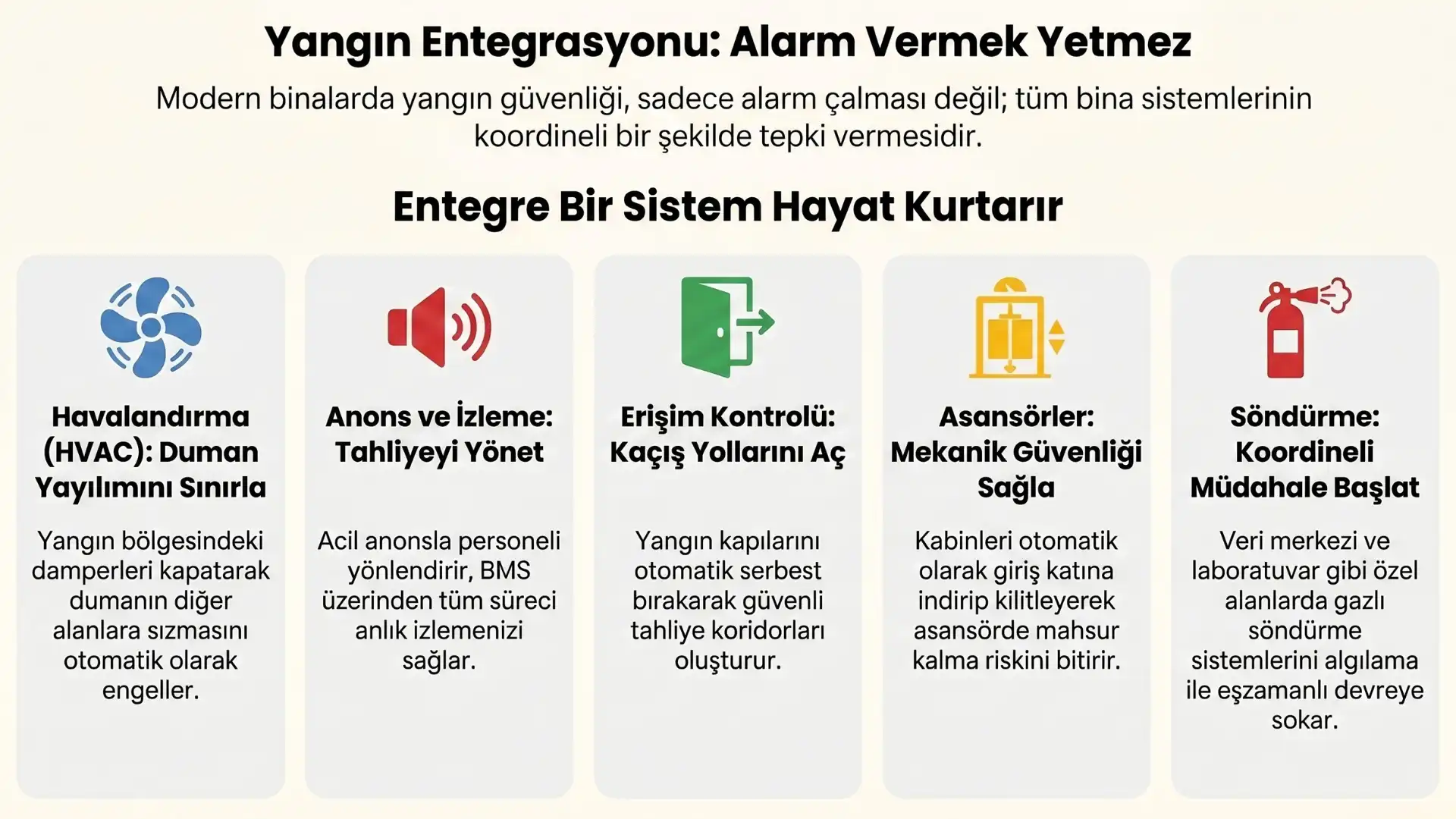
- Ventilation (HVAC) Integration: Automatic closing of dampers in the fire zone limits smoke spread.
- Emergency Announce System: Clearly communicates on which floor a fire has broken out and where personnel should evacuate. Panic is prevented.
- Access Control System: Automatic release of fire doors, ensuring escape corridors remain open.
- Elevator Integration: In fire mode, elevators descend to the ground floor and lock.
- Central Monitoring (BMS): All system statuses can be monitored from the security room and mobile devices.
- Sprinkler / Gas Suppression Integration: Coordinated activation of suppression systems in special areas such as pharmacies and data centers.
Dijinet designs these integrations during the project phase and implements them during installation. Adding them later is both costly and risky.
Turkish Legislation and Legal Obligations
For hospital administrators, this topic is a far more critical area of responsibility than technical selection. In cases where the fire detection system is incomplete or faulty, both corporate and individual criminal liability may arise.
| Legislation / Standard | Impact on Hospitals |
| Regulation on Fire Protection of Buildings | Mandatory automatic fire detection in healthcare facilities, evacuation plan requirements, panel capacity |
| TS EN 54 Series | Minimum technical standards that all components used (detector, panel, siren) must meet |
| Ministry of Health Hospital Service Quality Standards | Annual system maintenance and test report, fire drill requirement |
| Occupational Health and Safety Law (6331) | Protection of all employees against fire risk, employer responsibility |
| Insurance Terms | Most hospital insurance policies require the presence of an active fire detection system; an unmaintained system may lead to claim denial |
Dijinet prepares the necessary approval files for every project it delivers and provides technical support during official inspection processes.
How Does a Hospital Fire Detection Project Proceed?
Our projects follow a standard process. This process ensures that the hospital administrator knows what to expect at each stage.
| Stage | Duration and Scope |
| 1. Initial Meeting and Discovery | 1-3 days. Site visit, needs analysis, general scope definition. Free. |
| 2. Technical Project and Proposal | 5-10 business days. Detector plan, system architecture, cost analysis, legal compliance check. |
| 3. Proposal Approval and Order | After approval, product procurement begins. Delivery time is 2-4 weeks depending on stock availability. |
| 4. Installation | 1-6 weeks depending on hospital size. In parallel with active patient services, with planned stages. |
| 5. Testing and Commissioning | 3-5 days. Scenario tests, integration verification, user training. |
| 6. Maintenance Contract Commencement | Active from the commissioning date. Annual or periodic maintenance plan. |
Why Dijinet?
Instead of us answering this question, let’s list the concrete differences that set us apart from other companies:
- Active since 1985: Installed systems have been updated, maintained, and the reference list has grown. We have experienced the experience that a new company promises.
- Installation with own staff: We do not use subcontractors. Our installation team consists of Dijinet employees. When there is a problem, the contact person does not change.
- Certified product, authorized supplier: As an authorized dealer of Siemens and Teledata, we offer genuine products and an official technical support guarantee.
- Single point of responsibility: Project analysis, design, supply, installation, training, maintenance — all from Dijinet. You won’t have coordination problems.
- Regulatory knowledge: Our team closely follows Turkish fire regulations and EN 54 standards. We prepare your approval documents.
- Maintenance guarantee: We do not leave your system unattended after installation. Our periodic maintenance contract ensures your system is operational at all times.
Frequently Asked Questions
Should I choose an addressable system or a conventional system for a hospital?
In practice, an addressable system is recommended for every hospital with more than 10 beds. An addressable system shows not only which floor but also which room and which device triggered the alarm. This information is vital for operating room or intensive care coordination. Dijinet recommends the correct configuration according to your existing building infrastructure and budget.
How often do I have to perform maintenance?
Turkish legislation mandates testing and maintenance by an authorized company at least once a year. However, for large hospitals, maintenance every six months is recommended. The Dijinet maintenance contract is planned to coincide with the inspection period, and an official maintenance report is prepared.
Can the system be installed while hospital construction is ongoing?
Yes. A significant portion of our projects takes place during active construction or renovation processes. The installation plan is coordinated with the construction schedule. Phased commissioning is applied when necessary.
How can I be sure the system is working before a fire occurs?
In addressable systems, the panel continuously reports the status of each device. Fault or low battery warnings are automatically displayed. During periodic maintenance, devices are tested one-to-one using actual smoke and heat sources. After maintenance, a signed test report is submitted to the hospital management.
A Glimpse from Our References
Since 1985, we have designed and installed addressable fire detection systems in over 500 corporate projects, including hospitals, universities, factories, government institutions, and hotel complexes. For a reference list and project details, please contact us. For more products, you can visit Dijinet Market.
Let’s Evaluate Your Project Together
To analyze your hospital’s fire detection needs on-site, evaluate your existing system, or receive a new project proposal, please contact our engineering team.
| FREE HOSPITAL FIRE RISK ANALYSIS Fill out the ‘Get Project Proposal’ form on our website, and we will get back to you, or contact us directly: 📞 Phone: +90 312 473 23 65 📧 Email: info@dijinet.com.tr ✅ WhatsApp: 0(549) 423 42 00 🌐 Web: www.dijinet.com.tr Contact us for reference projects and service details specific to your hotel. |