


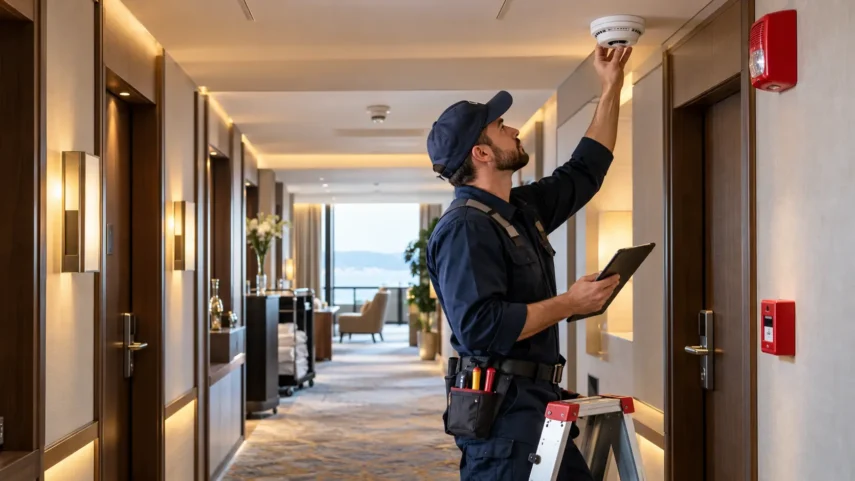
Opening a hotel for the season doesn’t just mean preparing the rooms. The fire alarm system, one of the most critical systems responsible for guest safety, must also be fully operational before the season begins. Especially in seasonally operating hotels, assuming the system works correctly after being idle for months during the winter period is a serious risk.
The winter and off-season period is the ideal time to review your hotel’s fire alarm system: the hotel is empty or has low occupancy, renovations are carried out during this period, and testing the system will not disturb guests. In this guide, we will go step-by-step through what needs to be checked in your hotel’s pre-season fire alarm inspection.
| Why is a pre-season check critical? Seasonal hotels remain closed or at low occupancy throughout the winter. During this period, humidity, dust, and power fluctuations can affect detectors and panels; batteries may weaken. Instead of assuming the system will work flawlessly when the season opens, testing it before opening is essential for both safety and legal compliance. |
Why Should Fire Alarm Systems in Hotels Be Checked Regularly?
A hotel is one of the most challenging structures in terms of fire: numerous enclosed rooms, sleeping guests, people unfamiliar with the premises, and the difficulty of nighttime evacuation. In such an environment, it is unacceptable for the fire alarm system to be out of service even for a moment. Regular inspection:
- Ensures guest safety: This is the only system that will alert a sleeping guest in time.
- Protects brand reputation: A fire incident in a hotel causes a loss of reputation that can last for years.
- Ensures legal compliance: Keeping the fire system operational and maintained is a legal requirement; it is sought after in tourism operating licenses and inspections.
- Maintains business continuity: A malfunction or fire occurring mid-season can halt the entire operation.
- Hotel fire alarm system
- In which buildings is a fire detection system mandatory?
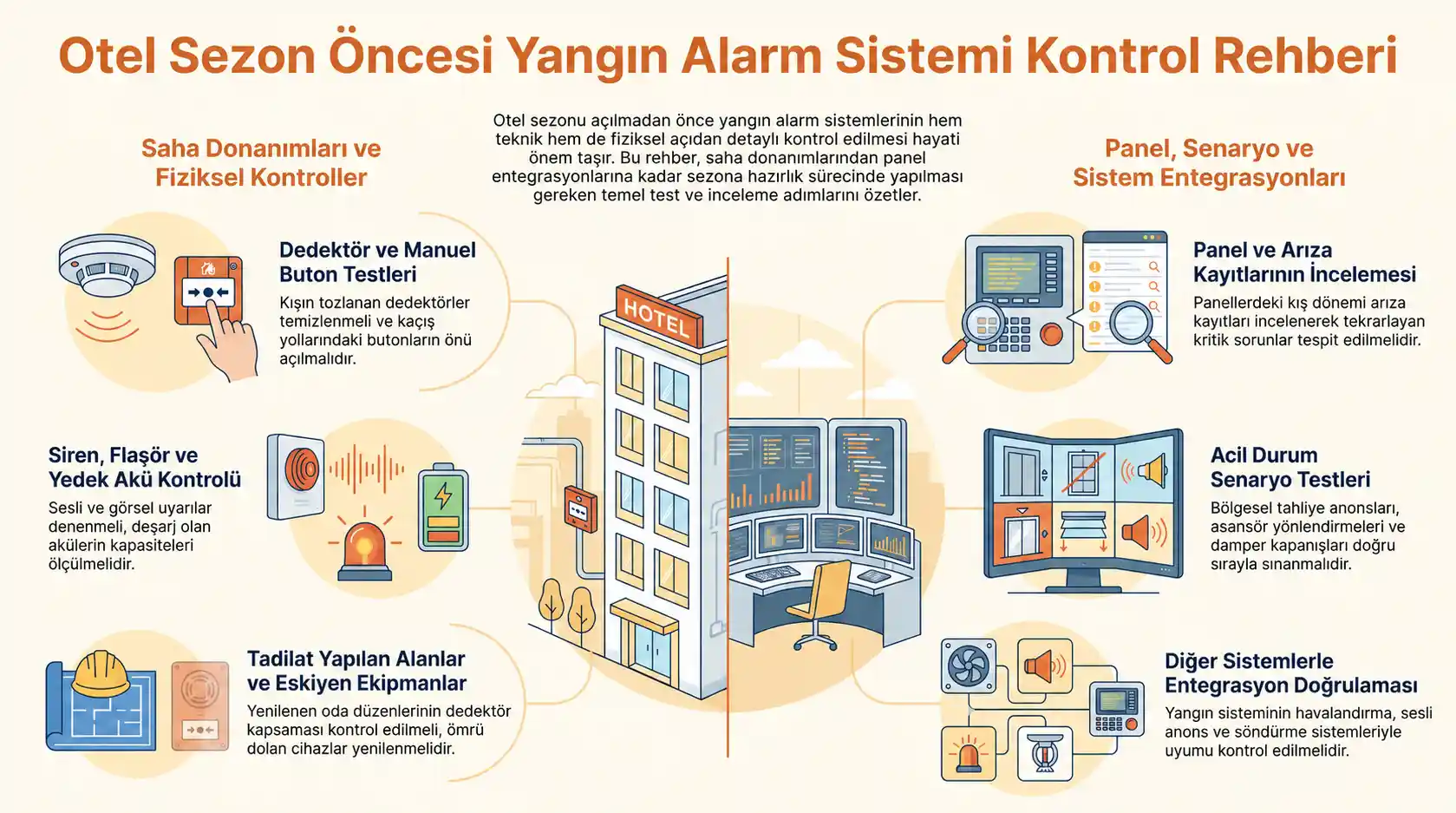
Pre-Season Fire Alarm System Checklist
The checklist below outlines what should be checked during your hotel’s pre-season assessment. Some of these checks can be observed by the operation; technical tests, however, must be carried out by authorized service personnel.
1. Detector Check
The cleanliness and operation of all room, corridor, lobby, and technical area detectors are tested. Detectors that accumulate dust during winter can lead to false alarms; in addressable systems, the panel already reports dirty detectors.
2. Siren and Strobe Light Check
It is tested that the sirens intended to warn guests during an alarm can be heard, and the strobe lights can be seen. Since these devices are not used for months, they must be tested pre-season.
3. Fire Alarm Control Panel
The panel’s fault warnings, event logs, and general status are examined. Fault records that occurred during winter are reviewed.
4. Manual Call Points
The operation of the call points in escape routes and floor exits is tested, and it is checked that their fronts are not obstructed.
5. Backup Battery and Power Supply
The capacity of the batteries that will keep the system running during a power outage is measured. Batteries that discharged during winter are the most frequently replaced parts pre-season.
6. Emergency Scenarios
Scenarios to be activated in case of fire (e.g., localized evacuation announcement, elevator recall, damper closing) are tested. It is verified that these scenarios operate in the correct zone and in the correct sequence.
7. Integration with Other Systems
The integration of the fire alarm with public address, ventilation, elevator, and, if present, suppression systems is checked. In a hotel, these integrations are central to guest safety.
8. Review of Fault Records
Past event and fault records of the panel are examined to identify recurring issues. A frequently recurring fault could be a sign of a larger impending problem.
9. Identification of Aging Equipment
Detectors that have reached the end of their lifespan and aging components are identified. Detectors have a certain service life; devices exceeding this period lose their reliability.
10. Impact of Areas Changed During Renovation
Renovations made during the winter (new partitions, changed ceilings, renewed room layouts) may have affected the existing detector placement. It is checked whether the altered areas are still correctly protected. This is one of the most frequently overlooked but most critical points before the season.
| Attention if you have renovated: Every physical change made during the winter (partition, ceiling, room merging/partitioning) can alter the fire detection coverage. After renovation, the system needs to be re-evaluated according to the new layout; otherwise, some areas may remain unprotected. |
Tests to be Performed Before the Season Starts
Beyond visual inspection, there are functional tests that must be performed before the season opens:
| Test | What is verified? |
| Detector activation test | That each detector generates an alarm and from the correct address |
| Siren/flasher test | That the warning is heard and seen in all zones |
| Button test | That manual call points trigger the system |
| Battery/power supply test | That the system remains operational during a power outage |
| Scenario test | That evacuation, announcements, and integrations work correctly |
| Panel fault scan | That recorded faults and warnings have been resolved |
The general method of performing tests is similar across all buildings; for detailed maintenance procedures and periods:
Importance of Maintenance Report and Records
All pre-season checks and tests must be reported and recorded. This report is not just a technical document; it is proof that the hotel has exercised due diligence during an audit, insurance process, or after a potential incident. Regularly kept maintenance records also protect hotel management from legal and administrative standpoints.
Request a Survey for Your Hotel’s Pre-Season Check
| Is Your Hotel Ready for the Season? Before the season starts, let our expert team check your hotel’s fire alarm system on-site: detectors, sirens, panel, buttons, batteries, and emergency scenarios should be tested, areas changed after renovation should be evaluated, and deficiencies reported.Pre-season discovery and evaluation are free of charge. For current products and news, you can follow us on Instagram and LinkedIn our accounts.Phone: +90 312 473 23 65 | WhatsApp: +90 549 423 42 00 Email: info@dijinet.com.tr | ‘Get a Project Quote’ form | Ankara and all of Turkey |
Related Content
- Hotel fire alarm system (homepage)
- Is your fire detection system really working? (inspection guide)
- Fire alarm systems (siren, flasher, voice evacuation)
Frequently Asked Questions
When should fire alarm maintenance be done in a hotel?
For seasonal hotels, the most suitable period is the winter/off-season period before the season opens. Since the hotel is empty or has low occupancy, tests do not disturb guests. Apart from this, periodic maintenance (3, 6, 12 monthly) should be carried out throughout the year by an authorized service.
Can the fire system be damaged in a hotel that remains closed in winter?
Yes, it can. Humidity, dust, and electrical fluctuations can affect detectors and the panel; batteries discharge. Therefore, testing the system before the season opens is much safer than assuming it’s working.
Should the fire system be re-checked after hotel renovation?
Absolutely. Changed partitions, ceilings, and room layouts during renovation can affect the existing detector placement; some areas may remain unprotected. After renovation, the system needs to be re-evaluated according to the new layout.
Is pre-season inspection a legal requirement?
Keeping the fire detection system operational and its periodic maintenance is a legal requirement; the responsibility lies with the business. Pre-season inspection is the most practical way to meet this obligation and be ready for tourism operation certification and inspections.