


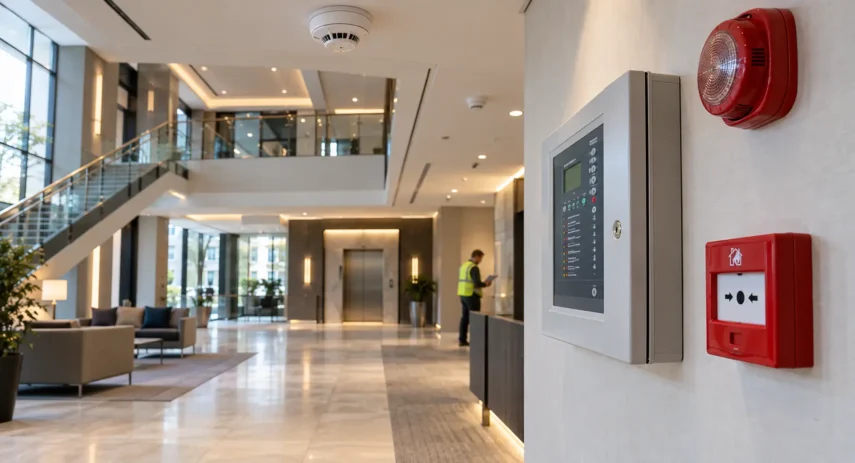
One of the most critical questions for a building owner, operator, or apartment manager is this: Is a fire detection system legally mandatory in my building? The answer to this question is not just about safety; it is also crucial for building permits, business opening licenses, fire department compliance, and insurance.
The fundamental regulation for fire safety in Turkey is the Regulation on Fire Protection of Buildings (BYKHY), which came into force in 2007. This regulation primarily links whether a fire detection system is mandatory in a building to two criteria: the building’s height and its total enclosed area (square meters). On this page, we discuss which buildings require a fire detection system and whether your building falls within this scope.
| Fire detection systems are legally mandatory in many structures, especially high-rise buildings, multi-story or large-area non-residential structures, hotels, hospitals, schools, shopping malls, factories, and facilities containing flammable materials. The exact requirement is determined by the building’s height, purpose of use, and area. |
| 2025 Current Development (important): With the regulation amendment dated July 1, 2025, it has been made mandatory for building owners and managers to address fire safety deficiencies (such as smoke detectors) in EXISTING apartments, complexes, and facilities. This covers not only new buildings but also older buildings in use. For details and up-to-date information, it is recommended to consult the authorized administration or an expert. |
How is the Obligation Determined? Two Key Criteria
BYKHY determines whether an automatic fire detection system is required in a building based on two main criteria:
- Building / structure height: Detection becomes mandatory in buildings exceeding a certain height.
- Total enclosed area (m²): Detection becomes mandatory in structures exceeding a certain square footage.
In addition to these, the purpose of use of the building (residence, accommodation, health, education, industry, commerce) changes the thresholds. For example, the threshold for a hotel is much lower than for a warehouse; because human density and risk are different.
Main Structures Where Fire Detection Systems Are Mandatory
The table below summarizes the main situations where a fire detection system is generally mandatory under the BYKHY (Building Fire Protection Regulation). Note: These are general guidelines; a definitive assessment is made specifically for the building.
| Structure / Situation | General Mandatory Threshold |
| High-rise buildings (including residential) | Building height above 21.50 m or structural height above 30.50 m |
| Non-residential buildings | 2-4 storey buildings with a floor area over 400 m²; or all buildings with more than 4 storeys |
| Accommodation (hotel, guesthouse) | Approximately above 6.50 m or 1000 m² |
| Inpatient healthcare facilities | Approximately above 6.50 m or 1000 m² |
| Educational buildings | Approximately above 21.50 m or 5000 m² |
| Manufacturing plant, workshop, warehouse | Structures exceeding the total enclosed area threshold (Annex-7) |
| Flammable/combustible material facilities | Production/storage with a total area over 1000 m² |
| Shopping malls and assembly-purpose structures | Mandatory according to area and capacity |
| Important warning: The values above are general guidance, and the regulation is updated periodically. The exact status of your building must be assessed by an expert based on its height, area, use class, and the current regulation. This page is for informational purposes, not legal advice. |
Fire Detection Obligation According to Your Building Type
Apartments and Mass Housing
Fire detection is mandatory in residences where the building height exceeds 21.50 meters (roughly 7 storeys and above). Although there is no legal obligation for residences below this height, detection is recommended, especially for boiler rooms, enclosed car parks, and common areas. With the 2025 amendment, addressing deficiencies in existing complexes is also on the agenda.
Workplaces, Offices, and Shops
For non-residential buildings, the threshold is lower: detection becomes mandatory for 2-4 storey structures with a floor area exceeding 400 m², and for all buildings with more than 4 storeys. It is also frequently required during business opening and operating license processes.
Hotels and Accommodation Facilities
The threshold in accommodation facilities is quite low; detection is mandatory in most hotels due to high human density and overnight stays.
Hospitals and Healthcare Facilities
The threshold in inpatient healthcare facilities is at its lowest level; detection is mandatory in almost all cases due to the difficulty of patient evacuation.
Schools and Educational Buildings
Detection is mandatory in educational buildings when the height or area threshold is exceeded; early warning is critical due to student density.
Shopping Malls and Commercial Centers
Due to high human density and large areas, addressable detection and often extinguishing systems are mandatory together in shopping malls.
Factories, Warehouses, and Industrial Facilities
Detection is mandatory in production and storage facilities where the total area exceeds a certain threshold, especially those containing flammable materials.
Should You Install the System Even If It’s Not Mandatory?
Even if your building is below the legal threshold, installing a fire detection system can be wise. In today’s world, where natural gas heating is widespread and the density of electrical devices is increasing, even a small building carries a serious fire risk. Furthermore, in insurance processes and compensation after a potential fire, the presence of the system can be decisive. Legal obligation is a minimum; true safety often requires more than that.
If Mandatory, Which System Should I Install?
For buildings falling under mandatory requirements, which system to install (conventional or addressable) depends on the building’s size and the number of sections. While conventional systems may be sufficient for small buildings with few sections, addressable systems are required for large buildings with many sections.
- Conventional fire alarm system
- Addressable fire detection systems
- How is a fire alarm system designed?
Mandatory Isn’t Just Installation: The Importance of Periodic Maintenance
An important point: Legal obligation does not end with merely installing the system. BYKHY and relevant standards also mandate that the installed system be kept in working order and undergo periodic maintenance. A system that is not maintained is considered legally deficient and may be non-functional in a real fire.
Is Your Building Under Obligation? Free Assessment
| Let’s Clarify Your Building’s Legal Status Whether a fire detection system is mandatory in your building is determined by its height, area, and purpose of use. Let our engineering team evaluate your building and clearly report your legal status and the required system. On-site inspection and preliminary assessment are free. For current products and news, you can follow us on our social media accounts you can follow.Phone: +90 312 473 23 65 | WhatsApp: +90 549 423 42 00 Email: info@dijinet.com.tr | ‘Get Project Offer’ form | Ankara and all of Turkey |
Frequently Asked Questions
In which buildings is a fire detection system mandatory?
According to BYKHY, it is mandatory in many structures, especially high-rise buildings (building height over 21.50 m), non-residential buildings with more than 4 floors or 2-4 story buildings with a floor area exceeding 400 m², hotels, hospitals, schools, shopping malls, factories, and flammable material facilities. The exact situation is determined specifically for each building.
Is a fire detection system mandatory in apartments?
Fire detection is mandatory in apartment buildings exceeding 21.50 meters in height (approximately 7 stories and above). Although not legally required in lower-rise residential buildings, it is recommended for boiler rooms, parking lots, and common areas. With the 2025 amendment, deficiencies in existing buildings have also become a matter of discussion.
Is a fire alarm system mandatory in my workplace?
In non-residential buildings, the threshold is low: detection is mandatory in 2-4 storey structures with a floor area exceeding 400 m², and in all buildings with more than 4 floors. It is also required during the processes of obtaining a business opening and operating license and fire department compliance.
What happens if a fire system, although mandatory, is not installed?
If the system, although mandatory, is not installed; serious consequences such as building permit and business license problems, fire department non-compliance, administrative sanctions, and exclusion from insurance coverage in case of a fire may arise. Furthermore, the responsibility lies with the building owner and manager.
Is it also mandatory for my existing old building?
The regulation amendment dated July 1, 2025, also made it mandatory to address fire safety deficiencies in existing apartments, complexes, and facilities. This means the obligation is not limited to new buildings; it is recommended to consult the authorized administration for the current situation.